MATERIAL SELECTION GUIDE
A practical guide to flexibility, outdoor exposure, printing and material selection for sign makers and B2B buyers.
Reflective sheeting can look similar on a screen while handling very differently in production. PVC, PET, PMMA and PC describe polymer materials used in the construction. Understanding their general characteristics helps you shortlist a film; the final choice still depends on the complete product, including its reflective layer, adhesive and surface treatment.
FLEXIBLE GRAPHICS
PVC / Polyvinyl chloride
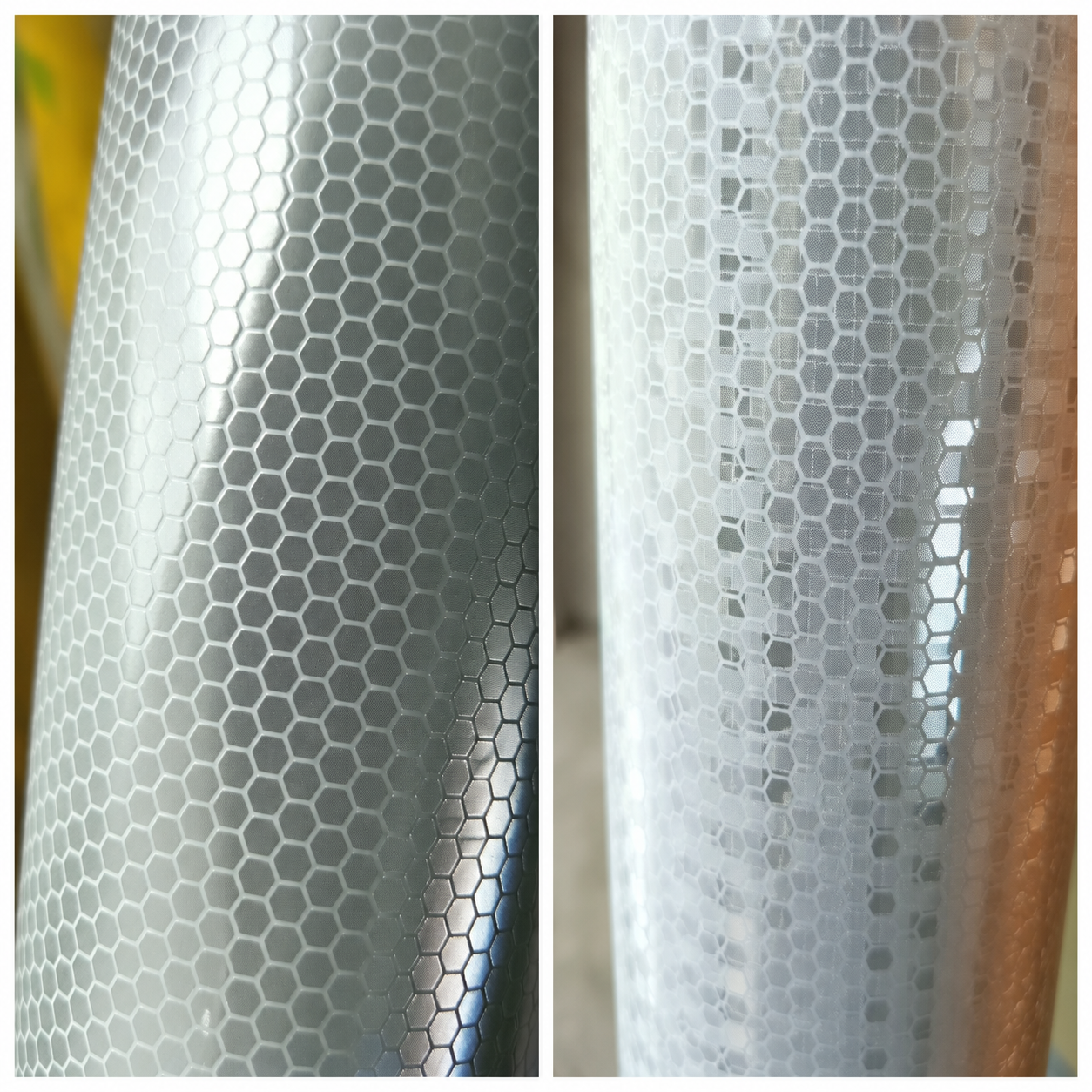
PVC honeycomb reflective film · surface comparison
Consider flexible PVC constructions for sign graphics and warning markings. Match conformability and outdoor exposure to the exact grade.
FLAT SIGNS & LABELS
PET / Polyethylene terephthalate
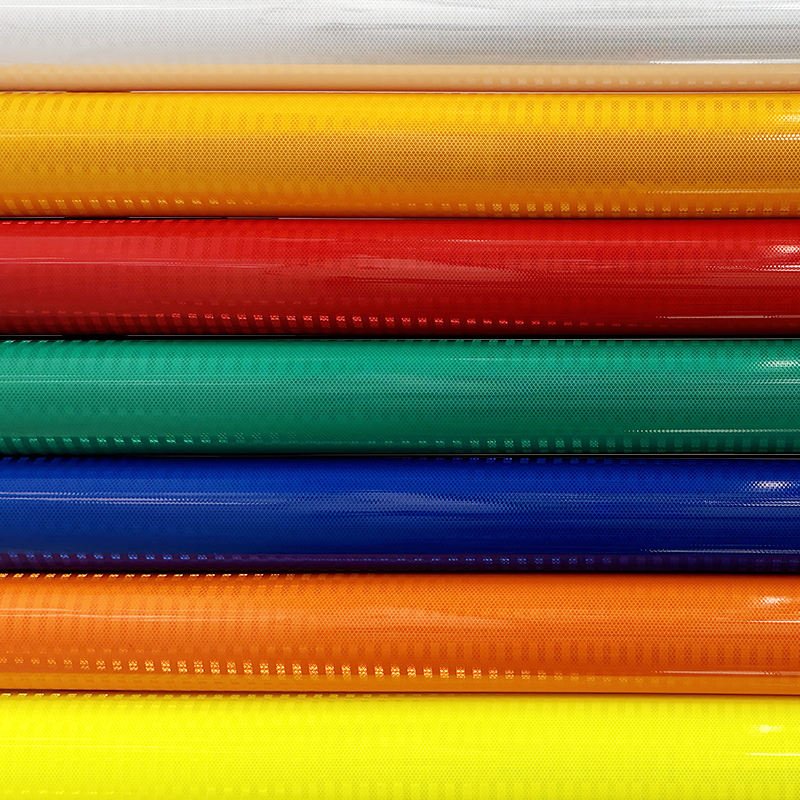
PET honeycomb prismatic self-adhesive film
A dimensionally stable polyester option for flat sign faces, labels and converted strips. Check the adhesive and printing system together.
OUTDOOR SIGN FACES
PMMA / Acrylic
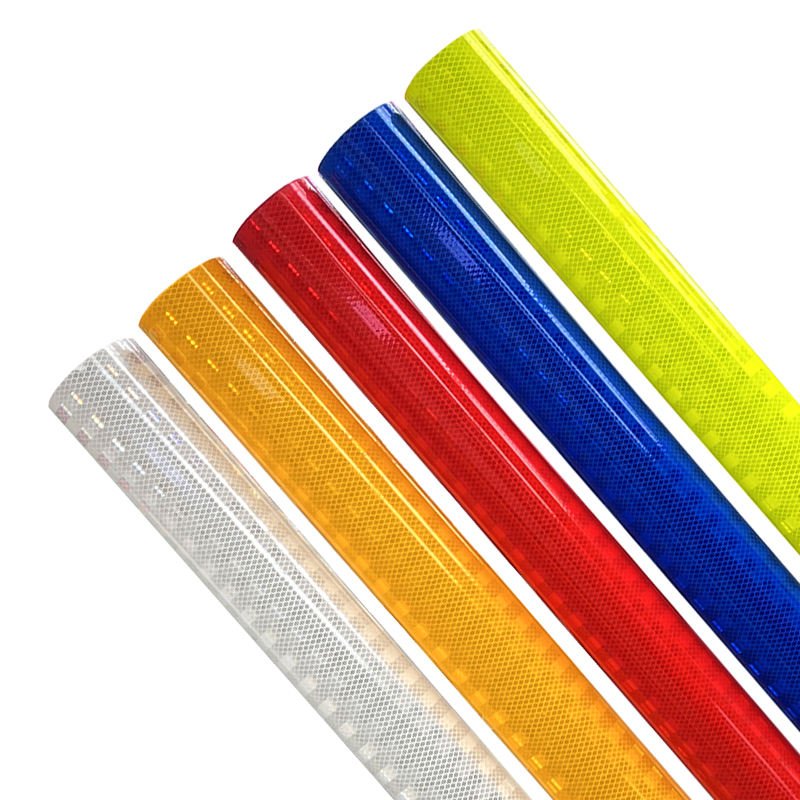
PMMA high-intensity prismatic reflective vinyl
Acrylic is valued for weather resistance. Select the optical grade, printing process and documented durability for the finished sign.
TOUGHNESS-LED PROJECTS
PC / Polycarbonate
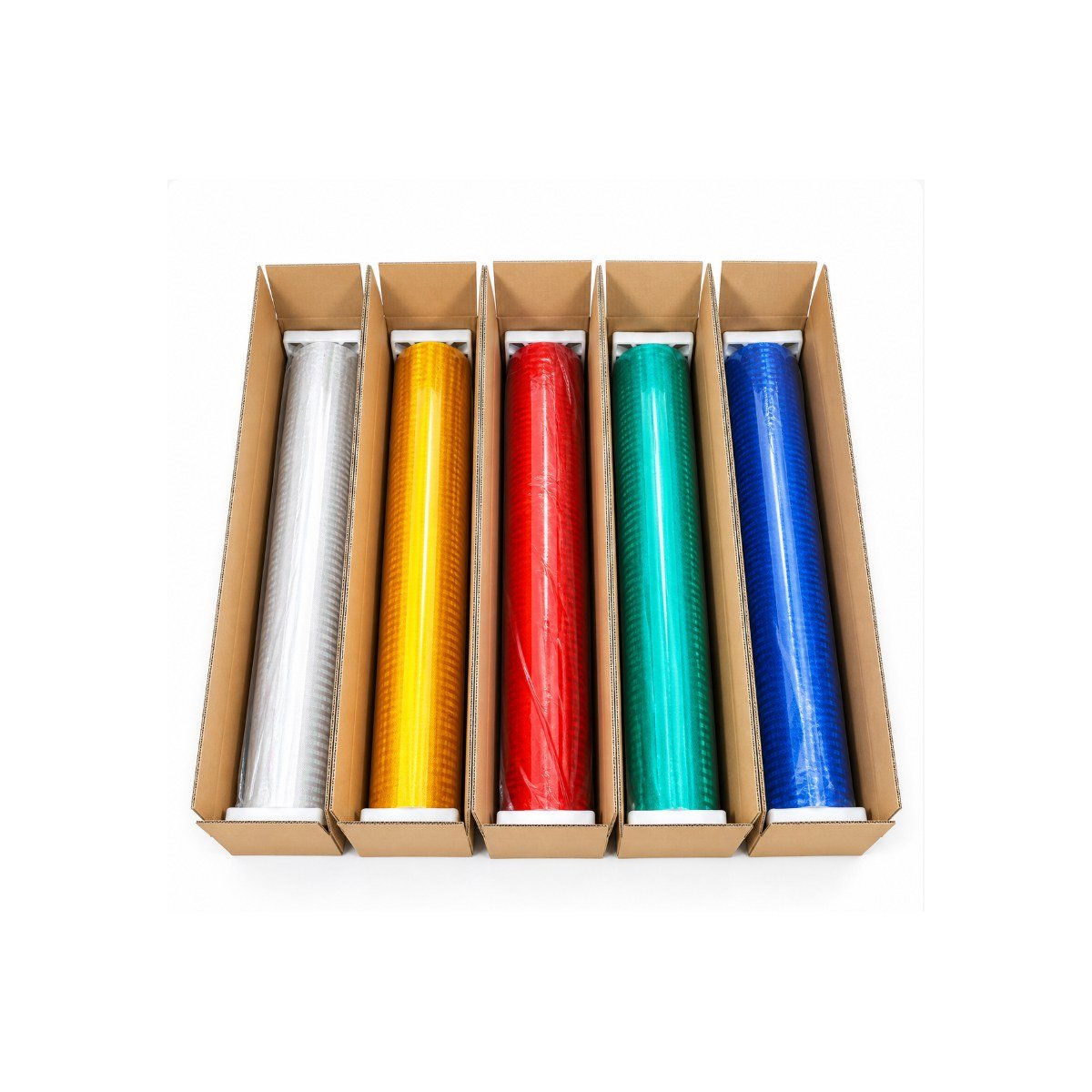
XY181 series photo · PC is a listed material option
Discuss PC when toughness and heat resistance matter. Confirm UV protection and the performance of the complete reflective construction.
The PVC comparison uses two surface photographs supplied by Xingyuan; the other photographs are from its catalog. Images show appearance, not a measured brightness comparison. The XY181 photograph illustrates a multi-material range; confirm the PC version when requesting a sample.
At a glance: what matters for your project
Use this table to narrow the discussion with your supplier. These are selection considerations, not universal specifications for every film made from each polymer.
| Material | Material-selection focus | Applications to discuss | Main checks |
|---|---|---|---|
| PVC | Flexible grades can suit shaped graphics; confirm the permitted curvature. | Sign graphics, warning markings and selected flexible applications. | Ask about shrinkage, exposure and the exact grade. |
| PET | Typically offers stiffness and dimensional stability for converting. | Flat sign faces, labels, barricade markings and strips. | Check conformability before using on tight curves. |
| PMMA | Acrylic is valued for outdoor weather resistance. | Outdoor sign faces and warning graphics with a suitable optical grade. | Confirm cutting and bend limits; avoid assuming all acrylic films handle alike. |
| PC | Polycarbonate is known for toughness and heat resistance. | Projects where those properties are relevant to the complete film. | Confirm UV stabilization, surface protection and application limits. |
01 / PVC: start with flexibility and the film grade
Flexible PVC reflective constructions are useful when a graphic needs more conformability than a relatively stiff film. The formulation and manufacturing process matter: a general sign film and a specialized vehicle-graphics film should not be treated as equivalent. Ask about the intended surface, permitted stretching and expected shrinkage.
PVC does not have a single outdoor lifespan. For example, specialist cast-PVC reflective products are offered for multi-year use, so a blanket “three months to one year” description would be misleading. For Xingyuan PVC prismatic rolls, specify the actual installation and request the matching product data.
02 / PET: dimensional stability for flat graphics
PET polyester films are commonly selected for dimensional stability, stiffness and reliable converting. These properties can help with flat labels, sign faces and repeatable cut pieces. A stiff film should still be assessed carefully on a curved surface: successful application depends on the film construction, adhesive and geometry together.
Xingyuan PET honeycomb film is listed with a pressure-sensitive adhesive backing. For printing, confirm the surface coating, ink system and curing method; the PET name alone does not establish compatibility with every UV, screen or digital process.
03 / PMMA: weather resistance for outdoor signs
PMMA, also called acrylic, is valued for optical clarity and weather resistance. For reflective sheeting, those material properties must work together with the optical structure and adhesive. Acrylic formulations can differ in toughness and flexibility, so use the selected film’s handling instructions instead of assuming that all PMMA films are completely rigid.
The Xingyuan PMMA prismatic product is offered for sign faces and custom warning graphics. Printing compatibility must be confirmed for the chosen process. A PMMA description or “high-intensity” product name does not, by itself, establish a seven-year service life or approval for a particular road-sign specification.
04 / PC: check toughness, UV protection and the whole construction
Polycarbonate is known for impact resistance and heat resistance. These general resin properties can be useful starting points, but a thin reflective laminate must be evaluated as a complete product. For outdoor exposure, ask whether the selected construction includes suitable UV stabilization or a protective surface; also check abrasion and cleaning requirements.
Xingyuan’s XY181 printable microprismatic sheeting lists PET, PC and PMMA material options. Request the PC version explicitly, with the required color, adhesive and printing method. The XY181 catalog lists up to 3 years, subject to construction and conditions. The summary below uses this catalog range as a reference, rather than assigning a service life to all PC films. Confirm the PC construction, exposure conditions and any warranty for the exact model being quoted.
Outdoor life, printing and price: compare the exact model
Three details to confirm before ordering
Outdoor life. Ask for the stated exposure conditions, installation direction, climate, color and finished print or overlay system. A vertical unprinted sign and a printed graphic exposed to strong sun may need different evaluations. Confirm whether a quoted duration is an expectation or a written warranty.
Printing and cutting. Send the printer, ink, curing method and artwork. Approve a sample made with the actual production process, checking ink adhesion, cut edges and the appearance of the reflective face. See our guide to UV, screen and solvent printing on reflective film for a process comparison and sample-approval checklist.
Price. Compare quotations at the same optical grade, color, thickness, adhesive, roll dimensions and order quantity. Polymer names alone cannot provide a reliable low-to-high price ranking. Include printing, conversion and replacement costs in the comparison.
Do not confuse material with reflective technology
PVC, PET, PMMA and PC identify polymer materials; glass-bead and microprismatic describe how the sheeting returns light. A polymer name is not a brightness grade. Compare reflective performance at the same color and measurement angles, using data for the exact product. See our glass-bead vs. microprismatic comparison for the optical differences.
A simple way to shortlist your material
For flat signs and labels: compare suitable PET and PMMA constructions against the required durability, printing and reflective performance. For a shaped graphic: ask about flexible PVC options and test the actual curvature. For a toughness-led application: discuss a PC construction and confirm that the finished film meets the use conditions. For regulated signs or vehicle markings, request documentation for the exact supplied model and destination requirements.
PLAN YOUR NEXT ORDER
Find the right reflective film for your project
Send your application, surface, color, roll or cut dimensions, quantity, printing process and destination country. Include any required reflective grade and outdoor service-life target.
Technical reading
General material background: ORAFOL — cast-PVC reflective film · Mylar — polyester label films · Röhm — PMMA films · Covestro — polycarbonate. These references explain material families; they do not certify Xingyuan products. Product examples and photographs link to the corresponding Xingyuan listings.
Reflective sheeting material comparison: summary
A side-by-side summary of the reference specifications supplied by Xingyuan for this comparison.
| Comparison point | PVC | PET | Acrylic / PMMA | PC |
|---|---|---|---|---|
| Product image | | | | |
| Nominal thickness | 0.34 mm | 0.42 mm | 0.40 mm | 0.42 mm |
| Reference outdoor life* | 3 months–1 year | 1–3 years | 7 years | XY181 range: up to 3 years; confirm the selected PC version and exposure conditions |
| Characteristics | Soft and flexible; conforms to curves; good extensibility. | Semi-rigid; dimensionally stable; tear-resistant; high flatness. | Rigid; highest UV resistance in this supplied comparison; high brightness; stable long-term retroreflectivity. | Impact-resistant; very tough; moderately bendable; resistant to high and low temperatures. |
| Printing / converting | Solvent inkjet printing; die cutting. | UV printing; screen printing; plotter cutting. | UV printing; screen printing. | UV printing; screen printing. |
| Price level | Low | Medium | High | Medium–high |
| Recommended applications | Temporary warning stickers; short-term promotional signs. | Safety signs; flat reflective strips; standard reflective tapes. | Permanent highway signs; traffic-engineering projects. | Truck body markings; vehicle reflective markings; curved sign panels. |
| Limitations | May yellow and become brittle under strong UV exposure. | Not suitable for pronounced curves; edges may lift. | Brittle; avoid bending or folding. | Surface scratches easily; lower UV resistance than acrylic. |
*These are supplied reference values for the versions being compared, not universal ratings for every film made from each polymer. Confirm the exact model, thickness measurement basis, printing compatibility and outdoor exposure conditions before ordering. Suitability for road signs and vehicle markings requires model-specific supporting documentation. The PC photograph illustrates the XY181 multi-material range. Its catalog states up to 3 years for the range; this is not a verified rating for every PC version or a warranty. Request the product-specific specification before ordering.